Bharat Mata: Exploring Pluralism and Controversy in M.F. Husain's Artistic Vision
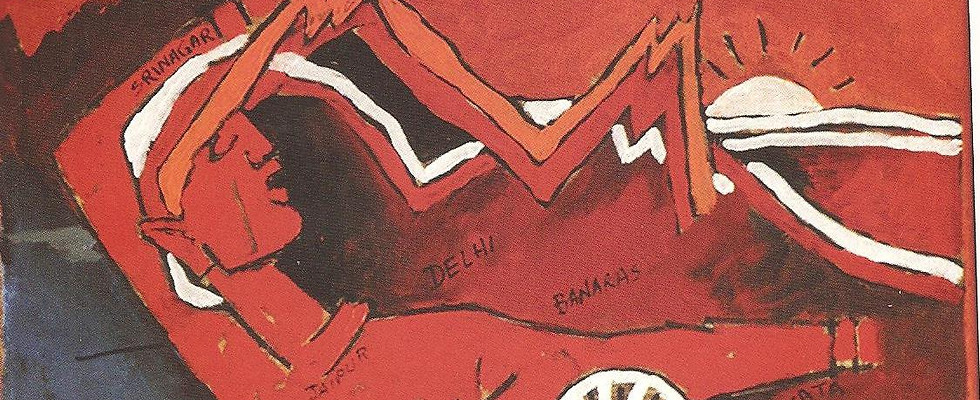
Details of Untitled (Bharat Mata), 2005 by M.F. Husain, the case study of this essay
Introduction
Maqbool Fida Husain (M.F. Husain) was a celebrated artist from India, renowned for his unique blend of modernism and Indian themes that pushed the limits of censorship in his homeland. One of his most notable works, Bharat Mata (Mother India) (Figure 1)was a symbolic representation of Indian nationalism (Bangdel n.d.), which led to grave repercussions reflecting the cultural and political landscapes of the country at that time. Despite its artistic merit, the work sparked controversy and became the subject of legal proceedings against Husain (Gilmartin and Metcalf 2011), ultimately forcing him into self-exile in London (Kothari 2020, 32).
This essay aims to explore the complexities of Husain's 2004 rendition of Bharat Mata and the socio-political contexts that influenced the work. It will also delve into how his upbringing nurtured this piece of art. Finally, it will discuss people's perceptions and reactions to the finalised artwork and what it represents.
Analysis of Bhara Mata
The artwork Bharat Mata, which translates to Mother India, was created by M.F. Husain in 2004. It was first displayed in 2006 at an online auction for earthquake relief by a private collector he sold the artwork to (Columbia University n.d.). It depicts a scarlet-coloured nude woman who is shaped like the silhouette of the Indian map with the names of Indian cities inscribed all over her body (Johnson 2015, 1). By being contorted to present herself in the shape of India (1), Husain’s work differs from other renditions by different artists as it makes Bharat Mata the personification of the land of India instead of a deity-like being representing India. The artwork is set against an orange background which represents the Himalayas (1). A bright blue surrounds the personified state resembling a sea (Johnson 2015, 4). The artwork also showcases various religious symbols (4).
Symbols
Husain depicted several Buddhist symbols in his artwork, one of them being the seated Buddha at the bottom right corner (Johnson 2015, 5). In the artwork's geographical context, Buddha is seated over the Indian Ocean, which may be a deliberate attempt by Husain to illustrate how Buddhism spread to neighbouring countries through the Indian Ocean (Blackburn 2015, 246). Next to Mother India, a crescent moon peeks out, reminiscent of the moon-star symbol of Islam (5). At the bottom left of the artwork, a sailboat is depicted, which represents “Christianity's ‘fisher of men’ ” (5). Finally and notably, the dharma chakra, also known as the wheel of dharma, is positioned at the centre of the artwork (Johnson 2015, 4). Originating from Buddhism, the dharma wheel symbolises the interconnectedness of all beings and the cyclical nature of life (Centre of Excellence 2024). It is an essential symbol in Buddhism, Jainism and Hinduism (MAP Academy 2023), representing unity and coexistence among India's diverse communities, transcending religious differences. Husain's abstract portrayal of Mother India, encircled by the diverse religions of the nation, illustrates her as a nurturing figure who cares for her people, transcending cultural differences (Dey and Tripathi 2022, 147) with a range of agricultural produce for them. It embodies the ideal of a pluralistic society grounded in the principles of dharma.
Colours
In classic Husain style, the artwork uses bold and contrasting colours that evoke a sense of vitality, representing India's rich diversity. The artwork's central figure is highlighted by the stark visual contrast created by the bright colours and darker tones. The dominant colour used in this artwork is red, primarily to paint the figure of Mother India. Unlike previous depictions of Bharat Mata, where the figure is draped in red clothing, Husain used a striking red for her skin tone. In Hinduism, red is regarded as an auspicious colour, representing fertility and prosperity, stemming from the red soil in India's fertile farmland (Chapman and Stacey 2015). The figure of Bharat Mata is usually associated with the colour red (Kamal 2018) as it symbolises that the land of India will continue to be fertile, bringing wealth to its people. In Husain's version of Bharat Mata, he personifies the figure of India as fertile and prosperous instead of being adorned with fertility and prosperity.
Style
Bharat Mata is painted in Husain’s recognisable modernist style but with inspiration from Indian folk art (Jana 2012, 135). One aspect of this work that makes it modern is a clear rejection of conservative artistic values such as realistic depictions (Tate n.d.). Husain used abstract and modernism to deepen the symbolic value of his work and accentuate its meaning, depicting a new, postcolonial India. Still retaining traditional Indian values, this artwork displayed a contemporary representation of Bharat Mata (Johnson 2015, 2).
The concept of Bharat Mata emerged as a response to the dominance of colonial narratives during the British Raj, and was designed to fortify Indian nationalism (Khurana and Nagaraja 2020).
Socio-Political Contexts in India
In Bharat Mata, there is such a strong focus on unity, especially religious unity (Johnson 2015, 5). This emphasis stems from Husain’s personal experiences as an Indian Muslim, having lived through pivotal periods in India’s history where there was constant disunity. Religion has been a matter of conflict within India for a long time (Dalrymple 2015). Since 1947, India and Pakistan have had deep-rooted mutual antipathy because of religious disputes between Hindus and Muslims (Dalrymple 2015). However, this was not always the case. Hindus and Muslims lived together as a society harmoniously up until the 19th century (Dalrymple 2005).
India was under British rule (British Raj), until 1947 (Dalrymple 2015). Instead of adapting to the local governance system, the British imposed a centralised state's will (Dalrymple 2015). To handle India's vast diversity, the British began defining communities based on religion and attaching political representation to them which emphasised community identity and led to disagreements between Muslims and Hindus (Dalrymple 2015). These conflicts escalated to violence and forced the solution of partition onto the British, so, they hastily drew up borders and left India after three hundred years, ending the British Raj (Dalrymple 2015). This partition ended a nearly 90 year long rule of Britain but left an indelible mark on India (Dalrymple 2015).
The repercussions of the partition are still evident in postcolonial India. In the early 2000s, several religious disputes occurred between Hindus and Muslims, one such being the Ayodhya dispute (Parikh 2005, 85). In 1992, Hindutvas, a group with militant ideologies of Hinduism (Anderson 2015, 46) who favour a solely Hindu India (Harvard Divinity School n.d.), demolished the Babri Mosque in Ayodhya, as they believed it was a religious Hindu site commemorating their God Ram, which later incited riots over the disputed land (85). This “transformative event demonstrates how religion and nationalism have become inextricably linked in modern India,” hindering the nation’s constitutional goal of becoming a (85) “secular democratic republic.” (The Constitution of India 2022). This event occurred a few years before the creation of Husain’s rendition of Bharat Mata, a piece that sought religious unity in postcolonial India (Johnson 2015, 1-7).
Background
Evident in his rendition of Bharat Mata, Husain is drawn to the theme of religion, possibly stemming from diverse religious influences from young. Husain was born in 1915 during the British Raj (Kothari 2020, 38). He spent his formative years in Pandharpur, Maharashtra (38) which is considered a spiritual capital (Nirvana India Enterprise n.d.). Though Husain was raised in a Muslim household, he was surrounded by the influence of other religions, more predominantly, Hinduism (Kothari 2020, 38-39). At three months old, he was sent to Indore, Madhya Pradesh (38), where Hindu and Muslim traditions were long integrated (Kapur 1978, 118). He was later sent to Siddhpur, Gujarat where he was given strict religious lessons (38). Further highlighting how every step of his formative years was impacted by various religions.
To further his career, Husain moved to Bombay (now Mumbai) (Kothari 2020, 38) during the 1940s, where he developed his signature blend of modernist and historical themes (Jana 2012, 135), showcased in Bharat Mata. This style was brought to life when he joined the Progressive Artists Group in 1947 (Kothari 2020, 39). This was a short-lived progressive art group founded in 1947 in Bombay by a group of artists who aimed to challenge India’s existing conservative art establishment by creating contemporary art that represented the post-colonial generation of India (Tate n.d.). Here, Husain was mentored by Francis Newton Souza on European modern art (39). Unlike the other artists, Husain did not want to remove the Indian aspect from his modern artworks (Kothari 2020, 43). Instead, he wanted to converse with the Indian public through his artworks and unite each other by translating their shared experience with his art (43). In his early career, he painted Indian village life (Kothari 2020, 40). As his career progressed, he focused more on religious artworks and Indian people (40). All in all, his artworks have always been centred around different aspects of Indian life and culture, yet depicted through an untraditional and modernist lens.
Aftermath of Bharat Mata
M.F. Husain was no stranger to controversy throughout his extensive career (Johnson 2015, 1). So, when Bharat Mata was first displayed in 2006, the backlash was expected, long-term repercussions were not (1). After the artwork was exhibited, protests erupted against Husain and his creation, resulting in charges being brought against him for spreading obscene material and offending religious sentiments (Columbia University n.d.). Husain was mainly attacked by Hindutvas who believed his work was disrespectful and obscene to Hinduism (The Hindu 2020). His work was criticised as he portrayed Bharat Mata nude (Gilmartin and Metcalf 2011, 70), despite Bharat Mata’s characterisation with female Hindu deities (Johnson 2015, 2). However, nudity has always been portrayed in ancient Hindu art (Macklin 2021), and the rejection of nudity only emerged after the enculturation of British values into Indian culture (Menon 2012, 71). Husain’s portrayal of Bharat Mata in nude brings back traditional Indian art norms. However, due to his Muslim identity, Husain was perceived as an outsider (Khan 2020, 57), which led to unjustified attacks on his work. His art was misconstrued as religious appropriation on what certain factions perceive as a Hindu-centric nation, when, in reality, Bharat Mata represented Husain's vision of reality: a pluralistic India.
Conclusion
Husain's interpretation of Bharat Mata is remarkable for its ability to divide and unite (Johnson 2015, 7) Indian communities. Unlike other depictions, Husain's version does not adhere to a particular identity for India; instead, it embraces the nation's diverse nature. Through his abstract approach, he captures the nuanced reality of India's societal landscape. While previous interpretations emphasised Hindu religious identification (Johnson 2015, 3), Husain's artwork diverged from this narrative stirring controversy among Hindu nationalists. It is noteworthy that Husain did not assign a name to the artwork; rather, it was named by the public (Dey and Tripathi 2022, 145). This highlights society's recognition of Bharat Mata in diverse forms, yet it also underscores the struggle to separate her from a Hindu identity, mirroring the broader challenge of secularising India.
Husain’s modern rendition of Bharat Mata continues to reminisce India’s socio-political landscape. Bharat Mata remains a catalyst in recognising the prejudice amongst India’s religious community by how Husain was treated after. Although the artwork objectively highlights India's religious diversity, it is still met with prejudice by a significant portion of the population in India (Johnson 2015, 1-7). This artwork remains a pivotal testament in the history of modern art as it is the example of how art can provoke introspection and shed light on internal biases. The perceptions of this artwork continue to highlight the division that persists among Indians, inadvertently building barriers and steering them away from a unified society. Husain's straightforward and idealistic declaration, “I am an Indian, and a painter, that is all.” (Reeves 2007) encapsulates a perspective that has the potential to secularise India.
Bibliography
All citations are done in Chicago Author-date 17th edition
Anderson, Edward. 2015.
“‘Neo-Hindutva’: The Asia House M. F. Husain Campaign and the Mainstreaming of Hindu Nationalist Rhetoric in Britain.” Contemporary South Asia 23, no. 1 (February): 45-66.
https://doi.org/10.1080/09584935.2014.1001721
Artnet. n.d.
“M.F Husain.” M.F Husain Biography. Accessed February 24, 2024.
https://www.artnet.com/artists/maqbool-fida-husain/biography.
Bangdel, Dina. n.d.
“Maqbool Fida Husain.” Mathaf Encyclopedia of Modern Art and the Arab World. Accessed February 25, 2024.
https://www.encyclopedia.mathaf.org.qa/en/bios/Pages/Maqbool-Fida-Husain.aspx.
Blackburn, Anne M. 2015.
"Buddhist Connections in the Indian Ocean: Changes in Monastic Mobility, 1000-1500", Journal of the Economic and Social History of the Orient 58, no. 3 (July): 237-266,
https://doi.org/10.1163/15685209-12341374
Centre of Excellence. 2024.
“Understanding the Buddhist Wheel of Dharma and Its Impact - Centre of Excellence.” January 26. 2024.
https://www.centreofexcellence.com/the-buddhist-wheel-of-dharma/.
Chapman, Sukie, and Jack Stacey. 2015.
“Celebrating India in Colour: Red: The Journey Blog.” Great Rail Journeys, July 22, 2015. https://www.greatrail.com/the-journey-blog/2015/july/celebrating-india-in-colour-red/#:~:text=As%20well%20as%20symbolising%20purity,ceremonies%20and%20used%20as%20offerings.
Dalrymple, William. 2015.
“The Mutual Genocide of Indian Partition.” The New Yorker, June 22, 2015. https://www.newyorker.com/magazine/2015/06/29/the-great-divide-books-dalrymple .
Dey, Debashrita, and Priyanka Tripathi. 2022.
“Art and Feminine Iconography: Locating the Aesthetic/Profane Body in the Bharat Mata Paintings.” National Identities 25, no. 2: 137–54.
https://doi.org/10.1080/14608944.2022.2079119
Gilmartin, David, and Barbara Metcalf. 2011.
“Art on Trial: Civilisation and Religion in the Persona and Painting of M. F. Husain.” In Barefoot Across the Nation: Maqbool Fida Husain & the Idea of India, 54–74. London: Routledge.
https://citeseerx.ist.psu.edu/document?repid=rep1&type=pdf&doi=30e26a545380e967124e0d4a5c19be9447e7e106
Global Freedom of Expression. 2023.
“Maqbool Fida Husain v. Raj Kumar Pandey.” Cases, November 10. 2023. https://globalfreedomofexpression.columbia.edu/cases/maqbool-fida-husain-v-raj-kumar-pandey/.
Harvard Divinity School.
“Destruction of Ayodhya Mosque.” Case Studies. Accessed February 25, 2024.
https://rpl.hds.harvard.edu/religion-context/case-studies/violence-peace/destruction-ayodhya-mosque.
Ians. 2021.
“Husain: India Is My Motherland but It Rejected Me.” The Hindu, November 17, 2021. https://www.thehindu.com/news/national/Husain-India-is-my-motherland-but-it-rejected-me/article16462793.ece.
Jana, Reena. 2012.
“M.F. Husain” Art+Auction, December, 2012.
http://prod-images.exhibit-e.com/www_aicongallery_com/Art__Auction_M_F__Husain.pdf
Johnson, Courtney. 2015.
“Bharat Mata: Mother of All India.” Dissertation, The Ohio State University.
https://bpb-us-w2.wpmucdn.com/u.osu.edu/dist/e/18897/files/2016/04/Bharat-Mata-2ghcus9.pdf
Kamal, Asif. 2018.
“Comparison of Bharat Mata by M. F. Hussain, D. Banerjee and Abanindranath Tagore.” Asif Kamal Blog, January 24. 2018.
Kapur, Geeta. 1978.
Contemporary Indian Artists. New Delhi: Vikas Publishing House.
Khan, Sahan. 2020.
“Social Exclusion of Muslims in India and Britain.” Journal of Social Inclusion Studies 6, no. 1 (October): 56-77 https://journals.sagepub.com/doi/pdf/10.1177/2394481120944770
Khurana, Maavni, and Kruthi Nagaraja. 2020.
“Indian Nationalism & the Symbol of Bharat Mata.” The Economics and Public Policy Cell, September 5, 2020. https://eppcbyssla.wordpress.com/issue-four-art-three/.
Kothari, Shay Afsheen. 2020.
"Painting a Modern India: F.N. Souza, M.F. Husain, & Artistic Identity After Independence." Senior Projects Spring 145.
https://digitalcommons.bard.edu/senproj_s2020/145
Kramer, Stephanie. 2021.
“Key Findings about the Religious Composition of India.” Pew Research Center, September 21, 2021. https://www.pewresearch.org/short-reads/2021/09/21/key-findings-about-the-religious-composition-of-india/.
MAP Academy. 2023.
“Dharmachakra.” Glossary, July 26. 2023.
https://mapacademy.io/glossary/dharmachakra/.
Macklin, Conor. 2021.
“The Nude in Indian Art, From the Antique to Independence.” Grosvenor Gallery. https://www.grosvenorgallery.com/usr/library/documents/main/the-nude-in-indian-art-grosvenor-gallery-frieze-masters-2021.pdf
Menon, Rekha T. 2012.
“The politics of the sensuous and the sacred body in India” In The Phenomenon of Beauty in Culture, edited by Agnieska Juzefovic, 71-88. Vilnius: Lithuanian Literature and Folklore
Mintcheva, Svetlana. 2019.
“On M.F. Hussain, Free Expression, and Pluralism.” National Coalition Against Censorship, March 8, 2019.
https://ncac.org/news/blog/5778-2.
Nirvana India Enterprise. n.d.
“Pandharpur Temple.” Accessed February 25, 2024.
https://www.pandharpurtemple.com/.
Parikh, Sheetal. 2005.
“Enshrining a Secular Idol: A Judicial Response to the Violent Aftermath of Ayodhya.” Case Western Reserve Journal of International Law 37, no. 1: 85–109.
https://scholarlycommons.law.case.edu/jil/vol37/iss1/6.
Reeves, Philip. 2007.
“M.F. Husain in the Center of India Art Controversy.” NPR, May 29, 2007. https://www.npr.org/2007/05/29/10438377/m-f-husain-in-the-center-of-india-art-controversy.
Republic of India. 2022.
The Constitution of India. Legislative Department. May, 2022. https://cdnbbsr.s3waas.gov.in/s380537a945c7aaa788ccfcdf1b99b5d8f/uploads/2023/05/2023050195.pdf
Tate. n.d.
“Bombay Progressive Artists’ Group.” Accessed February 25, 2024.
https://www.tate.org.uk/art/art-terms/b/bombay-progressive-artists-group.
Tate. n.d.
“Modernism.” Art Terms. Accessed February 25, 2024.